The EMET program lead hospitals (Hubs) work closely with local smaller emergency departments and emergency services providing educational support, guidance and feedback.
Of the over 600 hospitals with Emergency Departments (ED) or emergency services in Australia, only 25 percent are staffed by FACEMs. Hospitals without FACEMs are typically located in rural locations with clinical staffing models that include general practitioners, medical officers, nurses, paramedics and allied health workers.
For these locations, the EMET program gives much needed support in the form of education, training and supervision, to better equip the doctors and other healthcare providers at these hospitals to deal with critically ill or complex trauma patients.
Education is based on locally identified need and is mostly delivered at the regional site.
EMET also provides supervision and support for doctors working in EDs to complete the Emergency Medicine Associate Training Program (EMATP).
EMET Network
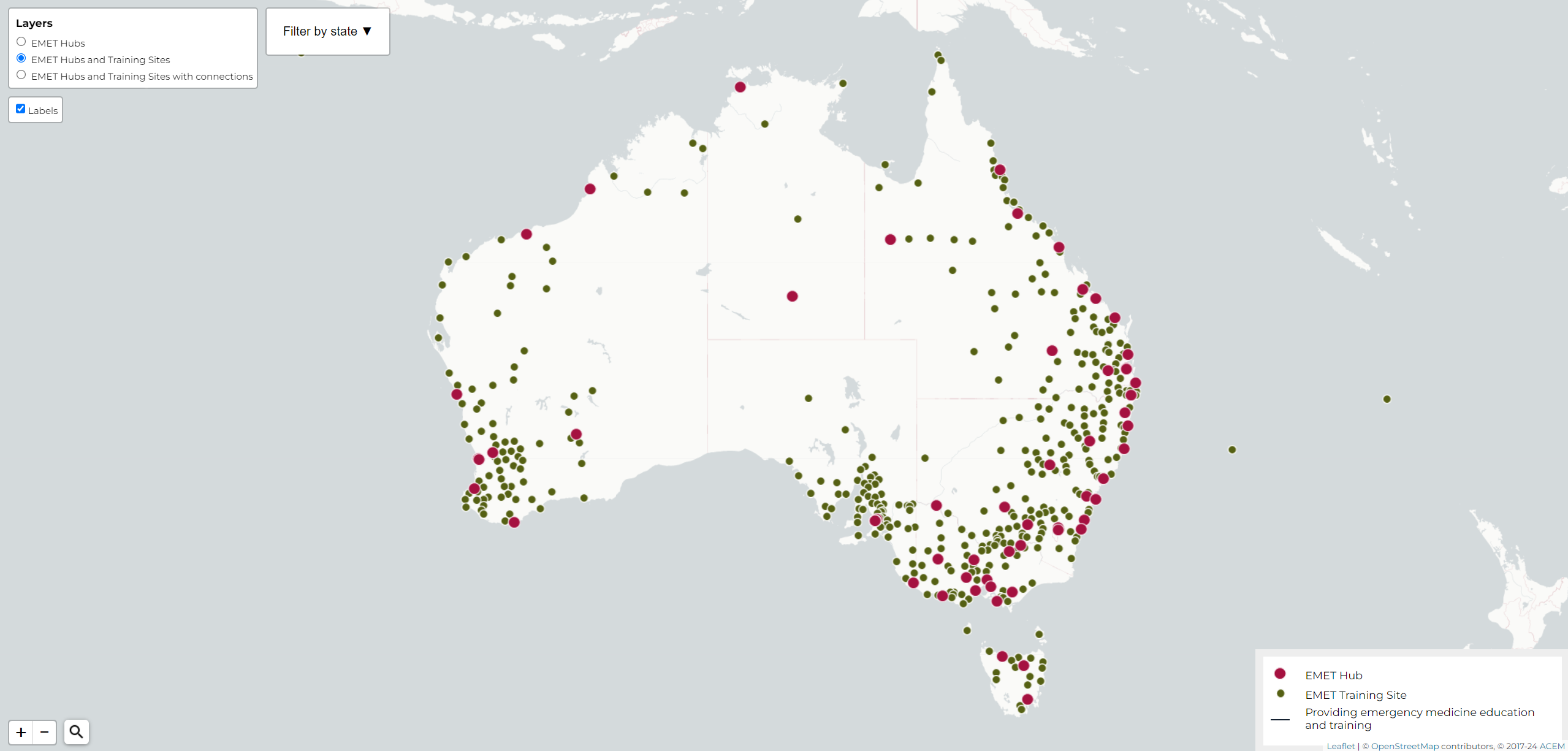
The EMET program supports 59 Hubs to deliver training and supervision to hospitals and health services with EDs or emergency services within their region. This training is delivered to over 540 health services nationally. The EMET Hubs and training sites are shown on the EMET network map (see below).
EMET Funding
EMET is funded by the Australian Government’s Department of Health, Disability and Ageing Specialist Training Program.
Applications for EMET funding is currently closed with funds allocated to 59 Hubs until the end of 2026. Eleven of these are new Hubs which have been funded from 2023.2.
Should further funding become available, request for expressions of interest (EOIs) will be advertised here and widely circulated.
-
EMET Hubs

|
LEAD - EMET HUB SITES
|
STATE/TERRITORY
|
LEAD - EMET HUB SITES
|
STATE/TERRITORY
|
|
Albury Wodonga Health [Albury Campus]
|
NSW
|
North Canberra Hospital
|
ACT
|
|
Albany Hospital
|
WA
|
North West Regional Hospital
|
TAS
|
|
Alice Springs Hospital
|
NT
|
Northam Hospital
|
WA
|
|
Bass Coast Health - Wonthaggi
|
VIC
|
Northeast Health Wangaratta
|
VIC
|
|
Bendigo Hospital
|
VIC
|
Northern Hospital [Epping]
|
VIC
|
|
Broome Hospital
|
WA
|
Northern Rivers NSW_Lismore Base Hospital
|
NSW
|
|
Bundaberg Base Hospital
|
QLD
|
Port Macquarie Hospital
|
NSW
|
|
Cairns Hospital
|
QLD
|
Prince of Wales Hospital
|
NSW
|
|
Coffs Harbour Base Hospital
|
NSW
|
Queensland Children's Hospital
|
QLD
|
|
Dandenong Hospital
|
VIC
|
Retrieval Services Queensland
|
QLD
|
|
Dubbo Base Hospital
|
NSW
|
Rockhampton Hospital
|
QLD
|
|
Geraldton Hospital
|
WA
|
Roma Hospital
|
QLD
|
|
Gladstone Hospital
|
QLD
|
Royal Adelaide Hospital
|
SA
|
|
Grafton Base Hospital
|
NSW
|
Royal Darwin Hospital
|
NT
|
|
Grampians Health - Wimmera Base Hospital
|
VIC
|
Royal Hobart Hospital
|
TAS
|
|
Grampians Health Ballarat
|
VIC
|
South Australia Postgraduate Medical Education Association - Perinatal
|
SA
|
|
Griffith Base Hospital
|
NSW
|
South Australian Postgraduate Medical Education Association
|
SA
|
|
Hedland Health Campus
|
WA
|
South West Health Campus (Bunbury)
|
WA
|
|
John Hunter Hospital
|
NSW
|
South West Healthcare [Warrnambool]
|
VIC
|
|
Kalgoorlie Hospital
|
WA
|
Sunshine Coast University Hospital
|
QLD
|
|
Latrobe Regional Hospital [Traralgon]
|
VIC
|
Tamworth Rural Referral Hospital
|
NSW
|
|
Launceston General Hospital
|
TAS
|
The Canberra Hospital
|
ACT
|
|
Lismore Hospital
|
NSW
|
Toowoomba Hospital
|
QLD
|
|
Mackay Base Hospital
|
QLD
|
Townsville University Hospital
|
QLD
|
|
Mildura Base Public Hospital
|
VIC
|
Tweed Hospital
|
NSW
|
|
Milton Ulladulla Hospital
|
NSW
|
University Hospital Geelong
|
VIC
|
|
Modbury Hospital
|
SA
|
Wagga Wagga Base Hospital
|
NSW
|
|
Mount Gambier and Districts Health Service
|
SA
|
Western Australia Country Health Service (WACHS) - Central EMET Hub
|
WA
|
|
Mount Isa Base Hospital
|
QLD
|
Western Australia Country Health Service (WACHS) - Emergency Telehealth Service
|
WA
|
|
Nepean Hospital
|
NSW
|
|
|
Further Information
For more information about EMET, email ACEM at [email protected].
Framework and Guidelines
The EMET Framework and Guidelines provide more details on the operations and funding criteria for EMET. You can find them below:
EMET Program Overview